

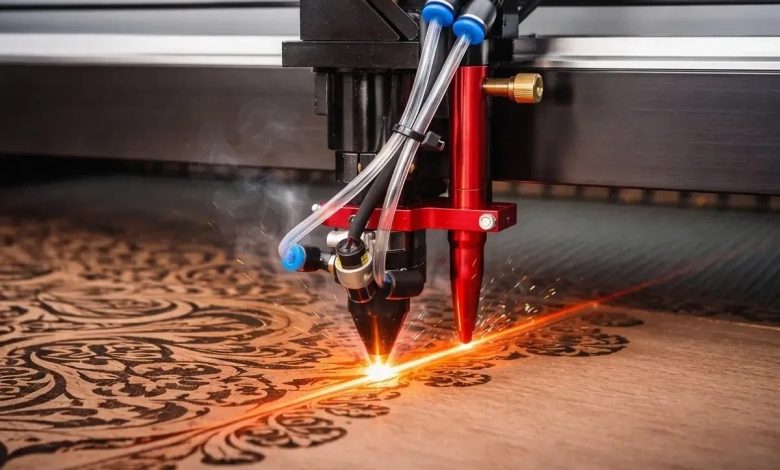
There is a moment in a small Canadian workshop when the desktop laser stops being the bottleneck and the order sheet starts being the bottleneck instead. The machine still works perfectly. It engraves clean, it cuts accurately, it gives no sign of failure. It has simply run out of bed. The quotes that used to fit now require splitting a design into pieces, or turning down a job that the shop could easily handle if the material went in whole.
That is the point where the question changes from “which laser should I buy?” to “which laser can absorb what the business is already being asked to do?” And the answer is not “the biggest machine the budget allows.” It is the machine that removes the specific limitation slowing production right now, with the least excess capacity possible.
The signals are concrete. If the material no longer fits, the limitation is work area. If the machine spends more hours engraving per piece than the margin can absorb, the limitation is speed. If multiple passes are needed on medium-thickness wood or acrylic, the limitation is tube power. The CO2 laser machines range maps onto those three limitations more clearly than a wattage ladder does.
The Pronto tier is the first answer to “the bed is too small.” The Pronto 40 90W, at roughly $4,799.99, offers a 35×24-inch work area with engraving speeds up to 1,000 mm/s—a speed OMTech describes as roughly 37% faster than competing cabinet lasers in its class. That combination changes the math for a shop whose jobs are getting wider and whose deadlines are getting tighter. A larger bed means the design does not need to be fragmented. The higher speed means batch jobs that used to take an afternoon can finish in an hour. Neither of those is a luxury feature. They are the difference between accepting a job and quoting it with a buffer that makes the margin disappear.
The Pro tier is the answer to a different question. The Pro 2440 and Pro 3655 are built for throughput and long-term durability, with 80W to 150W glass tubes, engraving speeds up to 1,200 mm/s, integrated water chillers, motorized autofocus, and hybrid servo motors on the X and Y axes. The Pro 2440 offers a work area of 2,440×1,220 mm—approximately a standard 4×8 sheet—which means full-sheet processing without cutting material down first. The Pro 3655 steps up to 130W or 150W for thicker materials and sustained production runs. At this level, the decision is no longer “can I do this job?” It is “how many units per hour do I need to produce for the margin to work?” A shop that does not need full-sheet capacity or continuous throughput will find the Pro tier is capital sitting idle rather than capacity gained.
The temptation when the order sheet grows is to jump straight to the largest model the budget allows. That is the wrong instinct. A 150W Pro does not do better work on a coaster than a 55W Polar. It does the same work, faster, on a larger bed, with a tube rated for hours of continuous operation. If the business does not need all three of those things at once, the larger machine is an unnecessary expense.
The practical upgrade path is to identify which of the three limitations—bed size, speed, or material thickness—is actually constraining production now, and choose the tier that eliminates that constraint. The OMTech Canada’s laser engraver and cutter lineup makes that progression readable because the software workflow stays consistent across tiers: LightBurn, the same file formats, the same design-to-cut logic. The hidden cost of changing machines—relearning a different software ecosystem—does not apply here the way it does when switching brands.
For a Canadian shop, the regional support model matters as much as the machine. OMTech Canada handles Canadian-dollar pricing, free shipping within Canada, and technical support in the same time zone. On a machine that is about to become part of the daily production flow, those details are not administrative. They are the difference between a shop that can promise a delivery date and one that depends on a response time it does not control.
The moment to cross the line is not the day the old machine breaks. It is the day the order sheet includes work the current machine cannot accept without penalizing the deadline or the margin. That day, the decision is no longer technical. It is economic. And having the next tier identified in advance is what makes it possible to decide with data rather than urgency.